


1. Introduction
This article outlines the copyright law concepts of works created by multiple authors and derivative works, with particular emphasis on distinguishing between joint works and adapted (derivative) works. Our analysis is primarily based on Hungary’s Act LXXVI of 1999 on Copyright (hereinafter: the “Copyright Act”) and its official commentary, the expert opinions of the Copyright Dispute Resolution Board (“SZJSZT”), as well as relevant judicial practice.
2. Multi-author works in general
From a copyright law perspective, works created with contributions from multiple authors may be divided into derivative works and into original multi-author works. In the case of derivative works, a new work is created on the basis of an existing work in such a way that the original and individual characteristics of the existing work are necessarily altered. In the case of original multi-author works, the individual creative contributions of the co-authors complement and reinforce each other without modifying one another’s creations. The latter category includes jointly created works, collective works and joint works.
In the case of jointly created works, the works of several authors are merged in such a way that the authors may not exercise their individual copyright with respect to the combined work [Copyright Act, Sections 6 (1)–(2)].
A collective work is a work in which the individual and original character lies not in the materials included in the collection but in the act of their selection, arrangement or editing. [Copyright Act, Sections 7 (1)–(3)].
The most important subgroup of original multi-author works is that of joint works. Joint works are connected by the unity of purpose and inspiration: the intention of the authors is to create a new, unified work in which the individual creations are indivisible or at least interdependent. Accordingly, a joint work may only come into existence as a result of the authors’ joint decision and simultaneous creative cooperation.
If the individual parts of a joint work created by multiple authors cannot be used independently, the co-authors will hold the copyright in the work jointly and equally. Nonetheless, any of the co-authors may take action against copyright infringement independently.
A connected work exists where the parts of the joint work can be used independently. In such cases, copyright may be exercised independently with respect to the individual parts; however, the connection of any part with another work requires the consent of all authors of the original joint work.
Depending on the type of the multi-author work, the copyright is held by:
- in the case of a jointly created work, the person who initiated and supervised the creation of the work or who made it public;
- in the case of a collective work as a general rule, the editor with respect to the work as a whole; or
- in the case of joint work, all co-authors.
In contrast to multi-author works, a derivative work is created through the use, adaptation or modification of an existing work in such a way that the individual characteristics of the original work remain recognizable but are necessarily altered. This category includes, for example translations or the adaptation of an original architectural design.
3. The concept and requirements of a joint work
A joint work may be created on the basis of the decision of multiple authors as a result of complementary and interdependent creative contributions.
A joint work may only come into existence through the authors’ conscious and simultaneous creative cooperation. For example, Gábor Presser and J. S. Bach cannot be considered co-authors with respect to the music of the ballet entitled A próba, as Bach, having died in 1750, obviously could not participate in the creative process. In such cases the new work cannot be regarded as a joint work but qualifies as an adaptation.
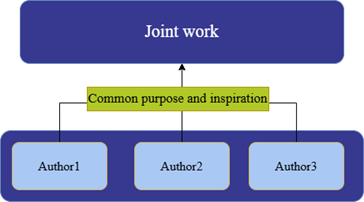
Overall, it can be established that a joint work exists if the authors
- act in a prior or at least tacit cooperation,
- participate in a single, unified creative process and
- have a common creative intent to create the work,
- the parts of which cannot be used independently
In the case of architectural works, the existence of multi-authorship can be established on the basis of the function and appearance of the building. The SZJSZT held in one of its rulings that in the case of an airport, the terminal and interior design plans qualify as independent works with individual and original character; however, this does not preclude them from being considered joint works individually, provided that they were created through the conscious and simultaneous cooperation of multiple authors [SZJSZT 11/2013].
In another decision, the SZJSZT interpreted the concept of adaptation in the context of building renovation. It held that if the renovation merely aimed at restoring the original condition, it did not constitute an adaptation. However, if the renovation resulted in a performance that differed from the original work (building), possessed an individual and original character, and was structurally integrated with the original work, an adaptation took place. Based on this, the SZJSZT concluded that in the case of the given property, both the original design and construction, as well as the subsequent renovations, could qualify as works protected by copyright [SZJSZT 19/2012].
Judicial practice is also consistent in holding that a joint work exists where a work is the result of the conscious cooperation of multiple authors, and where the combined work of the authors together endows the work with its individual and original character [Fővárosi Ítélőtábla, Pf. 20.634/2017/19]. Another decision confirmed that the actual existence of creative cooperation was an indispensable condition for joint work to exist, whereas in the absence of such cooperation, joint authorship could not be established [Fővárosi Ítélőtábla Pf. 20038/2018/8.].
4. The concept of derivative work and its copyright characteristics
Section 29 of the Copyright Act regulates the right of adaptation, under which the author has the exclusive right to adapt their own work or to grant authorization for adaptation. Adaptation includes any modification of a work that results in the creation of another work derived from the original.
Adaptation therefore represents an extreme form of modification or alteration of a work, where the modifying and supplementary elements are in themselves so substantial that they possess an individual and original character and thus constitute a creative performance. The resulting adapted work incorporates the intellectual expressions reflecting the personal characteristics of both the original author and the adapting author.
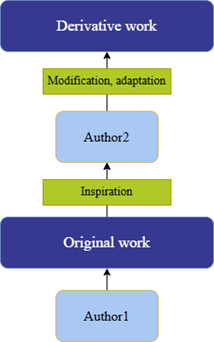
Pursuant to Section 4 (2) of the Copyright Act, an adaptation may itself be protected by copyright if it possesses an individual and original character. In such cases, copyright protection is of a derivative nature.
According to judicial practice, adaptation exists where a new, independent copyrighted work is created from an original work without the participation of the original author or designer. In this context, the Curia, Hungary’s highest court, held that in the course of adaptation, the designer was the person whose activity resulted in the creation of another individual work. If a new designer created a new design using the original plans, this did not constitute a joint work but an adaptation (Curia, Pfv.IV.21.647/2019/8.). An appeals court also ruled in another case that an independent copyrighted work was created with the adaptation of design plans. In such cases, the original designer had no control over the use of the new work (although their authorization would have been required for the adaptation). In decision Gf.I.30.465/2016/6., the appeals court confirmed that if a new designer prepared their own plans by “adapting” earlier plans without the authorization of the original author, this constituted unlawful adaptation. If you would like to know more about the issue of when a designer’s consent is required for alterations or reconstruction, please read our comprehensive legal analysis in a related article.
For the sake of completeness, we note that the following conditions must be met in order for a derivative work to qualify for copyright protection:
- the underlying work must be protected by copyright;
- the work resulting from the adaptation must possess individual and original characteristics distinct from the original work; and
- the adaptation must be lawful, meaning that it must not infringe the rights of the author of the adapted (original) work.
5. Distinguishing between joint works and derivative works
The table below provides an overview of the most important copyright law differences between joint works and derivative works:
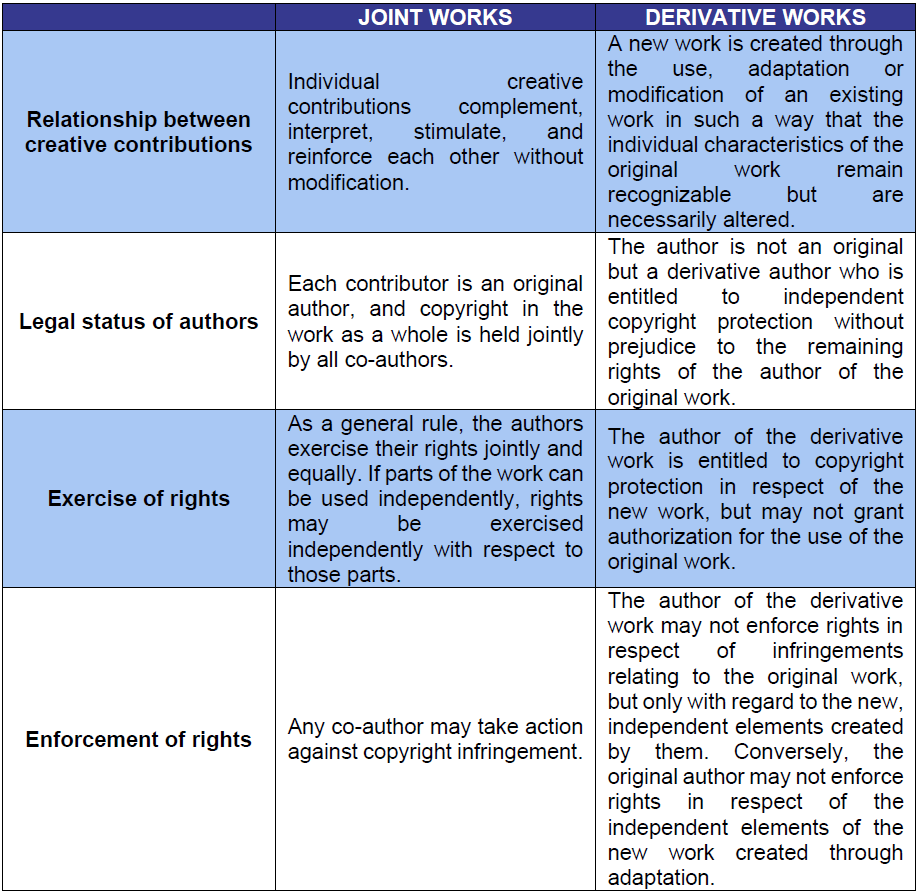
6. Summary
Therefore, within the category of multi-author works, the distinction between joint works and adapted works has fundamental importance as to how copyrights are created and asserted.
A combined interpretation of the statutory provisions, expert opinions, and judicial decisions described above suggests that drawing the line between joint works and adapted works always requires an examination of the actual circumstances of the given creative process. This has particular importance in the field of architectural works, where it is essential to clarify whether there was creative cooperation between the parties that could result in a joint work, or whether the new performance qualifies as an adaptation of the original work. The correct assessment of this issue is decisive not only for copyright qualification but also for the scope of exploitation rights and the possibilities of legal enforcement.
***
Authors: Zsanett Szabó
Balázs Bagi, a law student, contributed to this article.

If you are interested in more articles on construction law, please visit our website: Construction Papers
Copyright © 2026 CERHA HEMPEL Dezső and Partners – all rights reserved.
Mailing address:
CERHA HEMPEL Dezső és Társai Ügyvédi Iroda
1011 Budapest
Fő utca 14-18.
Magyarország
E-mail:
zsanett.szabo@cerhahempel.hu